
I recently read Fainos Mangena's excellent essay where she powerfully said,
“Rume rimwe harikombi churu — one person cannot surround an anthill. Building AI that works for all of humanity is work none of us can do alone.”
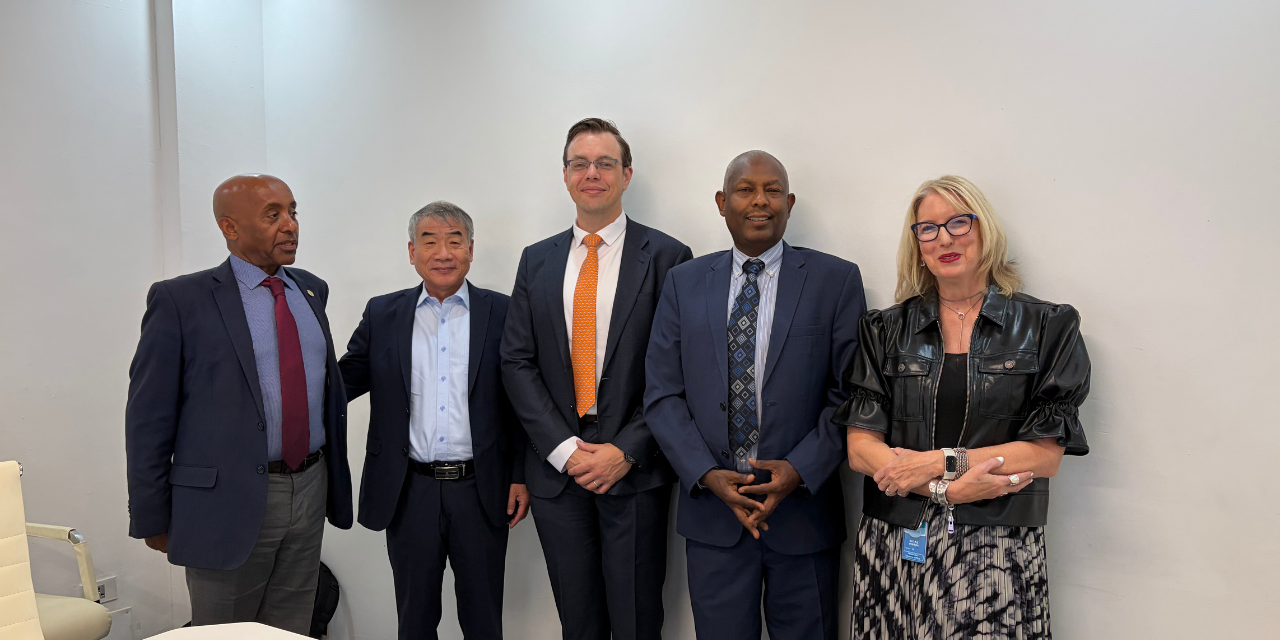
Given the news of the past two weeks, I was thinking about this in the context of a recent trip to Ethiopia I took with Dr. Daniel Donoho, President and Founder of the Surgical Data Science Collective (SDSC). SDSC, Ethiopia's Federal Ministry of Health (MOH) and surgical and university leaders from Addis Ababa University, Black Lion and St Pauls Hospital convened recently to review our partnerships progress and SDSC’s latest OB/GYN AI model. Seven months after signing our Memorandum of Understanding, the partners have demonstrated that collaboratively trained AI models can provide valuable insights which can be incorporated into offline training programs. Most critically, Ethiopian surgeons can use these models themselves to support teaching and learning new minimally invasive gynecological surgical procedures.
Amid all the AI hype and legitimate concerns regarding frontier models, it is important to also keep in mind the many operational, “human in the loop” demonstrations of how AI models built collaboratively with countries, can benefit everyone from Addis to Akron.
Our partnership relies on a collaborative approach and contributions from all partners. The Ministry leads data governance and coordination across the project, overseeing that Ethiopian laws are upheld and patients are protected. SDSC builds the AI models and sources surgical video data from around the globe, combining it with Ethiopian data and returning insights to surgical trainees for free via its Surgical Video Platform (SVP). Surgeons, both in Ethiopia and elsewhere, contribute de-identified surgical video data and validate the models and feedback by procedure type, making sure that the feedback hews to surgical and local practices, and improves patient outcomes.
In this project and others like it, SDSC works to modernize surgical training and provide data driven feedback similar to that available in other high performance fields (e.g., sports, aviation). Instead of an expert mentor providing you with feedback after a surgery, now trainees can turn to AI trained on 1000s of hours of actual surgeries and provide near real time feedback on your latest surgical performance. Sharing how they felt about receiving feedback, one surgeon remarked that after reviewing a low scoring case where the patient thrived, he was a bit embarrassed but also determined to improve. He called the discomfort of that feedback "a more mature professionalism" — not judgment, but a mirror held up collectively to indicate what you can improve upon next time.
Fainos Mangena's essay describes a similar approach to our partnerships when African nations build their AI. She posits that AI, as usually built, optimizes for the sovereign individual, while Africa’s approach should be grounded in a common moral position rooted in Hunhu/Ubuntu. “The values that flow from these foundations are demanding. Community loyalty: everything you do should benefit the group you belong to; Hunhu/Ubuntu discourages self-seeking tendencies. Consensus-building: no single view carries the day until the collective has spoken. Of great importance when examining the differences between Hunhu/Ubuntu ethics and Western ethics is the issue of human dignity and how the individual contributes to the community.”
Watching this partnership unfold over these last few months – I see these partners all working towards the good of the community with the privacy of the patient respected throughout. Can AI and national leaders work together to bridge continents to ensure these powerful tools serve us all? This seems to be the essential work of our time.

.png)