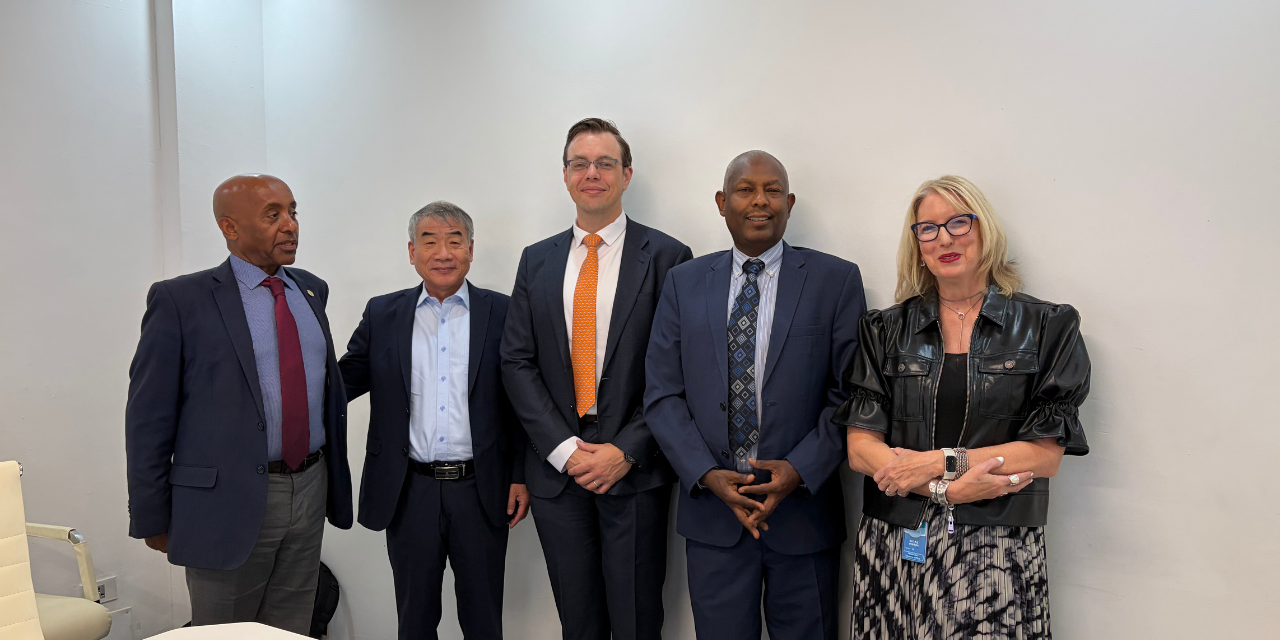
The Ethiopian Federal Ministry of Health (MOH) and Surgical Data Science Collective (SDSC) have formally partnered through a Memorandum of Understanding to provide OB/GYNs in the country with advanced surgical training powered by SDSC’s artificial intelligence (AI) models. Our goal: every Ethiopian woman can access World Health Organization (WHO)-standard OB/GYN surgical care within 100 kilometers of her community.

This collaboration builds on Ethiopia’s investment in artificial intelligence to develop new services for its citizens and existing investment by SDSC in using global surgical video data to improve global surgical performance.
This marks a critical milestone for SDSC in two ways. First, it shifts our current model of working primarily with surgeons and medical institutions to partnering directly with a government to co-design and test AI surgical models for use at national scale. Second, it is the first time SDSC will train AI models on OB/GYN surgical data – an important first step in our efforts to improve the lives of women and children everywhere through the use of AI.
The Training Bottleneck
Ethiopia struggles to provide advanced surgical care for its female population due to a significant shortage of trained OB/GYN surgeons. Considering that traditional specialist training typically takes more than six years and is often completed outside the country, there are very few new OB/GYN surgeons who graduate annually.
Even after graduation, there is limited access to advanced diagnosis and minimally invasive gynecologic surgeries (MIGS) that treat OB/GYN conditions, and constraints in resources and infrastructure leave scarce opportunity to maintain and sustain minimally invasive surgical programs. Furthermore, around 60% of specialists are concentrated in Addis Ababa in a nation whose population is 80% rural, leaving many regions without sufficient local access to higher-level surgical care.1
The gap in surgical capacity caused by both technological and clinician limitations carries immense consequences, with preventable complications and unmet surgical needs estimated to cause catastrophic surgery expenditures for 98% of households.2 Conventional training pathways alone are insufficient to meet the growing demand for quality and minimally invasive surgical care. So, it is time to address this gap with innovative, scalable, and locally driven solutions.
Towards Faster Learning And Stronger Systems
Through this partnership, MOH and SDSC will work together to integrate AI-driven surgical video analysis into Ethiopia’s existing training curriculum using Surgical Video Platform (SVP):
- SDSC will ingest video data and use it to co-develop Ethiopia-specific machine learning models for minimally invasive gynecologic procedures prioritized by MOH.
- These models will then be refined by MOH and used to build a training course in minimally invasive gynecologic procedures for new and existing surgeons – strengthening the capacity of national OB/GYN training.
The initiative is structured across four phases and led by MOH. The first phase of work has started with oversight from a technical working group composed of MOH leaders and surgeons from Addis Ababa’s St. Paul’s Hospital and Black Lion Hospital. This group will:
- Establish governance and oversight structures
- Standardize routine surgical video capture
- Train Ethiopian OB/GYN champions to lead platform adoption
- Advise SDSC on user needs for the first AI models tailored to Ethiopia’s surgical context
- Plan implementation pathways to scale the project to regions beyond Addis Ababa

As MOH leadership has emphasized, this is a country-led approach to responsible use of AI in healthcare. The collaboration fully aligns with Ethiopia’s Health Sector Transformation Plan II, Human Resources for Health Development 2029 Strategy, Digital Health 2030 Roadmap, and the National Strategic Care Plan, ensuring a coordinated and government-led approach to health system strengthening.
Ethiopian surgeons will guide how models are shaped and applied in their own context by drawing on non-personally identifiable data from around the world to build benchmarking tools for surgical training. Importantly, data practices are directed in close coordination with the government; strict data standards and review processes are applied before any information is analyzed. National data sovereignty is of the highest priority.
By combining Ethiopian and global surgical data and expertise, the partnership will support locally-led OB/GYN training and build a sustainable model for continuous competency development and specialization across the nation’s public health system. Over time, insights from Ethiopia will contribute to broader evidence generation and a global surgical knowledge community, which will enable multi-directional learning across borders.
A Model For Responsible AI In Health Systems
“This partnership reflects a shared commitment to building sustainable, locally governed solutions to global health challenges,” said Dr. Daniel Donoho, Founder and President of SDSC. “By pairing Ethiopia’s clinical leadership with AI trained on surgical video, we can help accelerate training, improve quality, and expand access to safe OB/GYN care – starting here, with a model that can inform health systems worldwide.”
This collaboration represents a broader shift towards responsible, evidence-driven use of AI in healthcare systems – where governments lead, local expertise shapes implementation, and measurable outcomes guide scale up.

SDSC has already demonstrated the potential of this approach in other surgical specialties, including neurosurgery at the Muhimbili Orthopaedic Institute, Tanzania. Now, Ethiopia is helping lead the way in defining how AI can responsibly strengthen national surgical systems, particularly in women's health – a critically underserved area.
“A recent Lancet paper urges that minimally invasive surgery (MIS) can be safe and effective globally, but only when training, systems, and quality control are in place.3 When those are missing, outcomes are worse and access is highly unequal. The limiting factor isn’t the technology itself, but the human variability in training, execution, and the absence of objective ways to measure performance. Surgical quality and equity problems are measurable, training variability is a root cause of outcome gaps, and safe scaling requires data, not anecdotes. Surgical video, when structured and linked to outcomes, is one of the few ways to make surgical performance visible at scale.” – Dr. Donoho
Surgical video analysis is not out of reach. With the right partnerships, governance, and commitment, it can become a powerful tool for accelerating training and expanding access to high-quality care.
If you would like to learn more about this program, or explore opportunities to collaborate, please contact our partnerships team: info@surgicalvideo.io
1. Gebregzi AH, Teko EB, Tantu AD, Jale NT, Getahun GK, Asemu YM. Assessment of surgical capacity and productivity in high-volume Ethiopian Hospitals: Mixed Method Study. BMC Health Services Research. 2025 May 27;25(1). doi:10.1186/s12913-025-12892-6
2. Osebo C, Grushka J, Deckelbaum D, Razek T. Assessing Ethiopia’s surgical capacity in light of Global Surgery 2030 Initiatives: Is there progress in the past decade? Surgery Open Science. 2024 Jun;19:70–9. doi:10.1016/j.sopen.2024.03.015
3. Kamarajah SK, Kouli O, Ng WH, Pius R, Shaw C, Ademuyiwa A, et al. Safety and equity in scaling minimally invasive surgery worldwide in 109 countries using cholecystectomy as a tracer procedure: a prospective cohort study. The Lancet Global Health [Internet]. 2026 Feb;14(2):e199–212. doi:10.1016/S2214-109X(25)00476-0