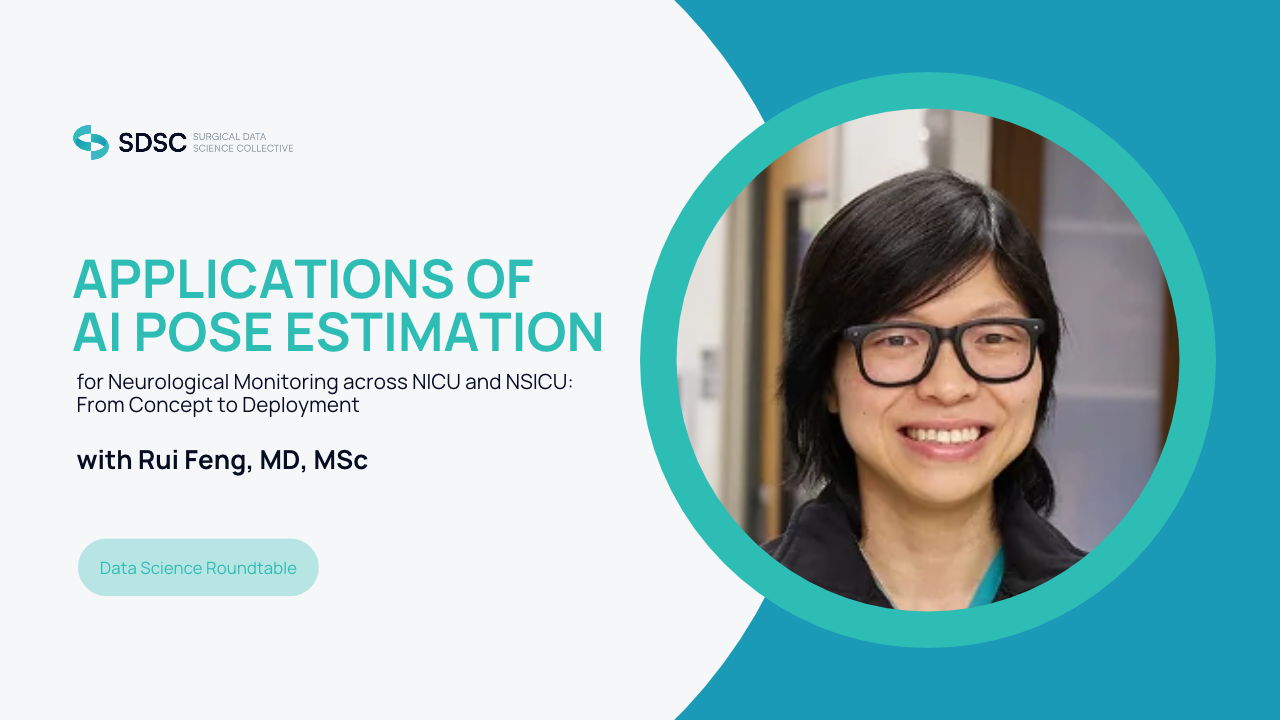
SDSC’s Data Science Roundtable with Dr. Rui Feng – incoming neurosurgery attending at Mount Sinai, New York City – showcased her group’s innovative work exploring artificial intelligence (AI)-powered pose estimation as a new form of continuous neurological monitoring.
Neurological status can change rapidly, however, patients in intensive care are typically assessed through intermittent neurological examinations. With this in mind, Dr. Feng’s NIH-funded team are investigating whether computer vision that tracks human movement can provide a more continuous, objective picture of patient movement and neurological function; akin to what telemetry does for the heart and lungs.
Their retrospective study analyzed more than 5,000 hours of video-EEG data from 88 neuroscience ICU patients, alongside data from an epilepsy monitoring unit. The team found that AI-derived movement measures correlated strongly with established measures of consciousness, including the Glasgow Coma Scale and Richmond Agitation-Sedation Scale. Importantly, the models showed no significant differences in performance across key demographic groups.
The team has developed an edge-based system that runs on an iPhone, allowing video analysis to take place locally without sending patient footage to the cloud. Early deployments have explored movement trends, subtle “micro-movements,” left-right symmetry, and sleep interruptions.
Dr. Feng also discussed parallel work applying pose estimation in the neonatal ICU, including monitoring sedation, cerebral dysfunction, and spontaneous movements associated with neurodevelopment.
Looking ahead, the team is working towards prospective multicenter trials and richer multimodal monitoring – including eye movements, facial activity, speech and cognition – with the goal of developing a clinically useful “neuro-telemetry” system that can support earlier detection and better-informed neurological care.