“When we started Surgical Data Science Collective, the idea that AI could meaningfully improve surgical care felt promising, but distant.” – Dr. Daniel Donoho
In healthcare, an inflection point is defined as a moment or event that fundamentally changes the long-term trajectory, strategy, or outcome for a patient, an organization, or a health system. Across health systems, training bodies, regulators, and governments, the conversations around artificial intelligence (AI) have shifted from “does this belong?” to “how should AI be integrated safely, effectively, and equitably?
When SDSC began, surgical video and AI were entirely unconventional tools, so we had to build the foundations from the ground up:
- Data access and trust – partnering with surgeons and institutions willing to share video and expertise.
- Proof of concept and research validation – demonstrating that surgical video can be transformed into meaningful insights.
- Adoption, training, and outcomes – embedding tools directly into real-world practice.
This past year, SDSC has crossed decisively into the third phase.
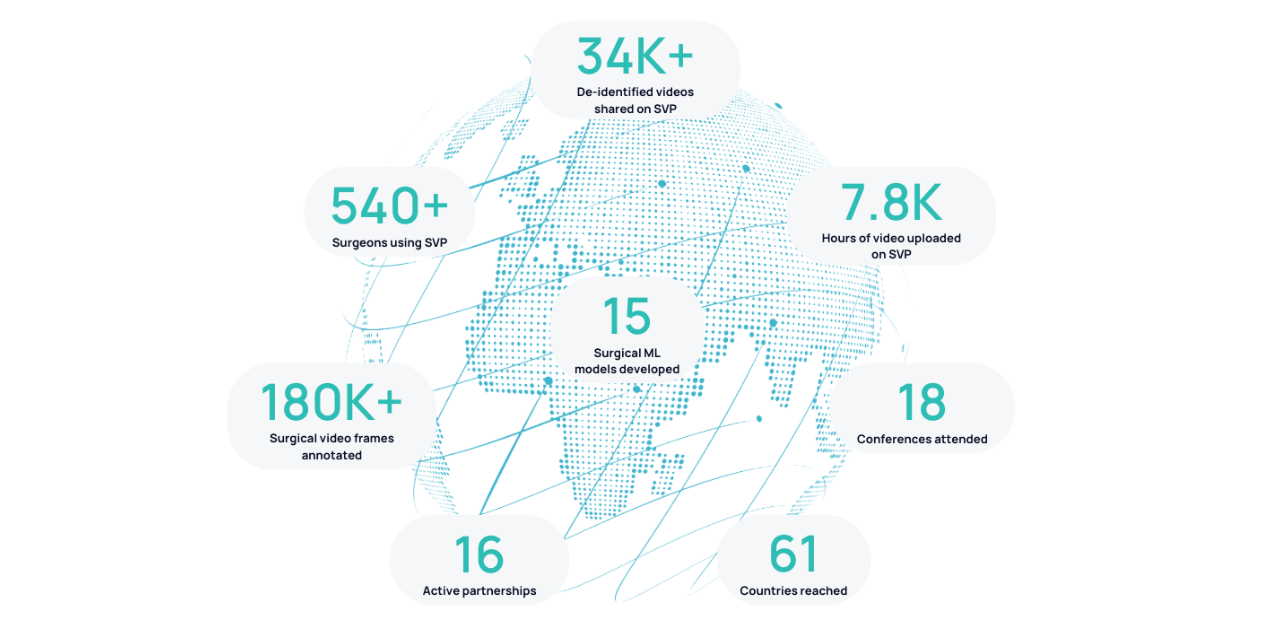
Since our inception, SDSC has proven feasibility, built credibility (particularly in neurosurgery), and delivered a real, useful product in the Surgical Video Platform (SVP). Now, more than 500 users engage with the platform, contributing to a growing, independent repository of over 34,000 surgical videos, 7,500+ hours of surgical footage, and 180,000+ surgical video frames annotated.
What is all of this for?
Still, surgery remains one of the greatest blind spots in global health. Billions of people lack access to safe, timely, and affordable surgical care, and the consequences are devastating for women’s health, trauma outcomes, cancer survival, and so much more.1 But with robotics, endoscopy, and laparoscopy all revolutionizing the operating room, surgery has fast become one of the most data-rich activities in modern medicine. We now sit on a huge gold mine of videos, decisions, and knowledge that no longer has to disappear once a case is over.
Surgical video is the missing link.
SDSC exists for the sole reason of turning everyday surgical practice into data that is learnable, sharable, and improvable.
As our founder Dr. Daniel Donoho iterates: “People have died to teach us things that we are forgetting on a daily basis.” Surgical video allows us to preserve and disseminate that hard-earned knowledge across borders and continents.
Our mission now spans across the US and into 61 countries, reaching surgeons and trainees through platform access, training programs, and outreach efforts. In addition, our 16 partnerships across academic, clinical, and global health institutions have helped us build one of the largest independent surgical video repositories in the world and expand the collective memory of surgery for the benefit of patients everywhere.
The start of our impact
This year marked the beginning of measurable return on investment.
NeuroKids to Tanzania: Scaling the ETV-CPC Assessment Tool
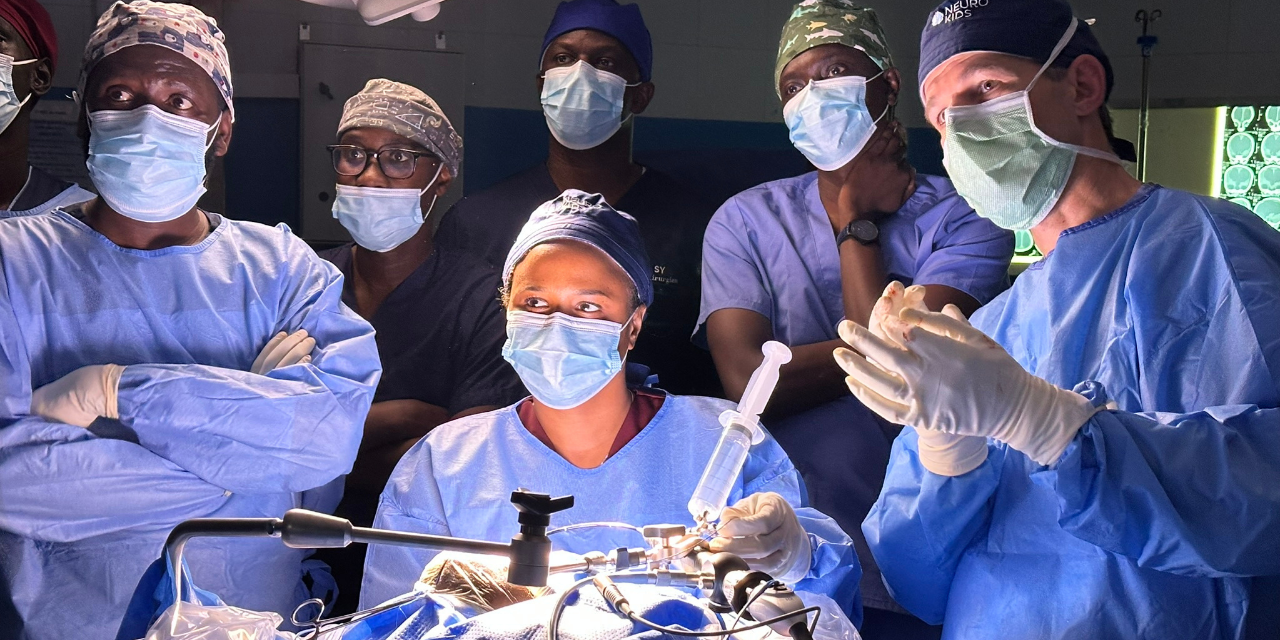
The ETV/CPC assessment tool originally began as a collaboration with NeuroKids to address the urgent need for better pediatric hydrocephalus treatment. The concept was then transformed into a scalable, AI-powered assessment tool embedded directly into SVP for all users.
Soon after, our pilot study at Muhimbili Orthopaedic Institute (MOI) in Tanzania became a great success story in real-world feasibility, with surgeons at the site now actively using the tool to receive structured, objective feedback on their procedures. We are proud to announce that this infrastructure has since expanded to a second site too: Kilimanjaro Christian Medical Center (KCMC).
Women’s Health is Next
What has now been proven in neurosurgery will shortly be accessible to the OB/GYN community as well. Our new partnership with the Ethiopian Federal Ministry of Health marks SDSC’s official expansion into women’s and maternal health at a national scale, and we are itching to see how much of an impact we can make in 2026.
The machine learning evolution
This year in particular marks 3 years of incredible machine learning innovation at SDSC. Since our start, the ML team has:
- Created multiple surgical datasets with custom ontologies across procedure types, including PTS breakdown, ETV/CPC, and suturing task assessment.
- Built an integrated labeling pipeline that connects dataset storage and visualization.
- Implemented model monitoring as part of an active learning workflow to ensure dataset diversity, surface classes for improvement, and accelerate dataset development.
- Developed a new data pipeline with automated annotation review and duplication control to flag for outliers, improve recall, reduce bias, and stabilize evaluation metrics.
All of these systems allow SDSC to maintain rigor as we work quicker to support the global research community. To date, SDSC has developed 15 ML models. Many more of which are in progress and deeper technical insights will be shared with the community in upcoming presentations and blogs.
Global recognition
As the work at SDSC matures, its impact is becoming increasingly visible on the global stage.
In 2025, SDSC was recognized as a Bronze winner at the Anthem Awards for Best Use of AI in Health. We participated in 18 conferences and forums, including Dr. Donoho’s talk at the Global Digital Health Forum, and SDSC’s formal commitment to the Boston Declaration, pledging free global access to our Platform Library of hundreds of neurosurgical videos and associated AI/ML models.
We also debuted our Data Science Roundtable Series (DSRT), where clinicians, scientists, and engineers from around the world join a monthly forum to discuss how surgical video, data science, and AI can meaningfully improve global surgery. Since its inauguration, our DSRT has welcomed over 190 attendees, and we are looking forward to the 2026 lineup.
Thank You
… To our surgeons, researchers, partners, and supporters.
Your willingness to collaborate, share, data, test tools, and challenge assumptions has brought SDSC to this moment. You are the engine driving our growth, and in 2026 we invite you to:
- Introduce SDSC to colleagues and institutions
- Engage with our data, research, and training programs
- Join us in accelerating the responsible use of AI in surgery
As one team, we can continue our journey towards safer, accessible, and excellent surgery for everyone.
1. Nepogodiev D, Picciochi M, Ademuyiwa A, Adisa A, Agbeko AE, Aguilera M-L, et al. Surgical health policy 2025–35: Strengthening Essential Services for tomorrow’s needs. The Lancet. 2025 Aug;406(10505):860–80. doi:10.1016/s0140-6736(25)00985-7